
Statutory Information
Governance
Sound governance is a pre-requisite for a Trust that is able to effectively ensure that everything it does is based around the concept of Children First.
We are a not-for-profit, limited by guarantee organisation that operates several individual nurseries and schools. The legal entity consists of Members and Trustees. Our Accounting Officer is Louise Lee.
Governance Structure
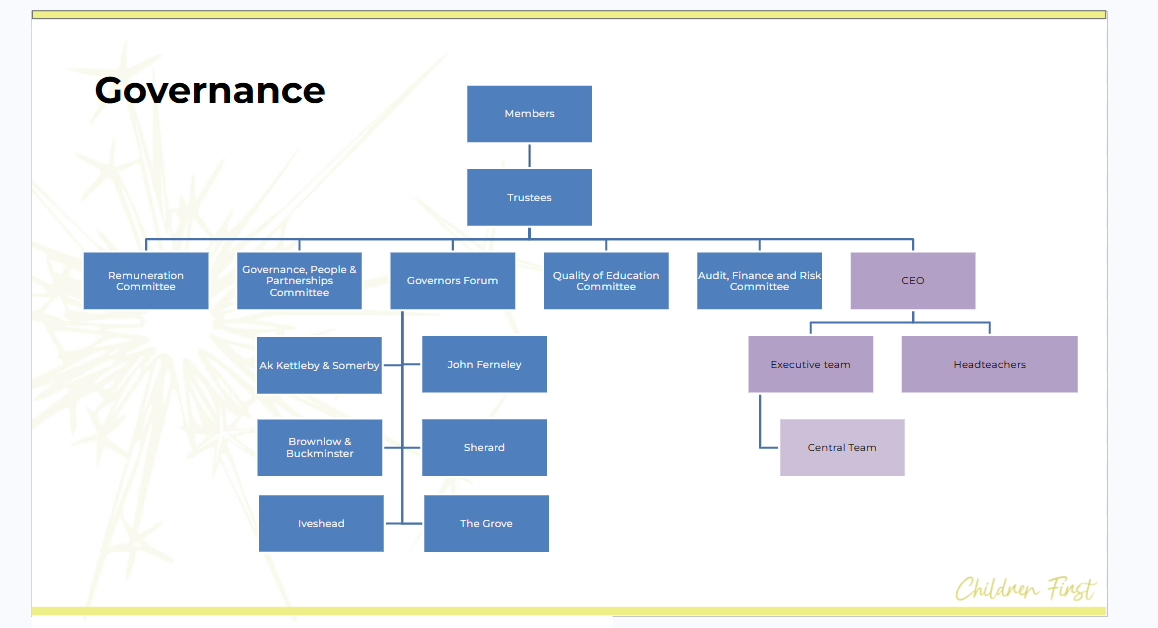
Members and Articles of Association
Members are the ultimate "owners" of the Trust and have the overall control, with the ability to appoint some of the Trustees and the right to amend the Articles of Association (our written rules of operation that set out what we can and can't do).
Further information on our Members can be found here.
Trustees and Scheme of Delegation
Our Trustees are the 'directors' of the organisation and are responsible under Company Law for the operations of the Trust. Their core functions are to set the strategic direction of the Trust, hold the CEO to account for performance and to ensure that the Trust adheres to the various legislation and regulations by which we are bound. They are also responsible for ensuring that the Trust demonstrates financial probity.
Our chair of trustees is Drew Richardson-Walsh, and the vice chair is Peter Dundas. Drew's term of office ends on 11th September 2026, and the board have appointed Catherine O'Sullivan who will be elected as chair on 12th October 2026.
The Trustees set and use the Scheme of Delegation to empower those involved in governance at the Trust to govern the day-to-day affairs of the individual organisations within the Trust. This document is a powerful tool to ensure that every decision taken within the Trust is made on the basis of our guiding principle of Children First.
Our Board of Trustees has three sub-committees; the Audit, Finance & Risk Committee, the Governance, People and Partnerships Committee and the Quality of Education Committee, whose terms of reference are reviewed annually.
Please click here for details on dates appointed, term of office and the appointing body for Trustees.
The governors and trustees can be contacted on [email protected].
Further information on our Trustees can also be found here.
Trust Board Attendance - Mowbray Education Trust 2024-25
Trust Board Attendance - Mowbray Education Trust 2023-24
Trust Board and Committee Membership and Link Roles 2024-25
Register of Interest - Trustees, Members and Senior Staff 2025-26
Register of Interest - Trustees, Members and Senior Staff December 2024
Register of Interest - Trustees, Members and Senior Staff 2023-24
Local Advocacy Committees
The Trust Board delegates some responsibilities to Local Advocacy Committees. These committees are school level committees established to look at school-level matters on behalf of the Trust Board. Their responsibilities are set out in the trust scheme of delegation.
Advocacy committees will:
Monitor stakeholder engagement:
- Understand how schools communicate with stakeholders and review its effectiveness.
- Support the trust’s strategy with particular regard for civic and community engagement
- Build strong relationships with school stakeholders (parents, pupils, staff, wider community)
- Welcome communication from stakeholders
- Participate in ad hoc panels (such as complaints or appeals) as required by the trust
- Create and support opportunities to market the school and trust in the wider community to help the headteacher to build its profile and reputation.
- Oversee school website content in terms of community engagement.
- Support student councils and parent forums.
- Engage effectively with learners and others in their community, including – where relevant – parents, carers, employers and local services
- Ensure that wellbeing is embedded within the culture of the school for the headteacher, staff, and pupils.
- Promote and celebrate events organised by the Trust and its schools.
Monitor standards:
- Receive and review high level information on pupil progress, attainment, behaviour and attendance
- Provide support and challenge to the headteacher through curiosity and in support of trust and school plans, but mindful that the CEO and Director of Education are responsible for standards and line management.
- Pay particular attention to the effectiveness of support and the quality of education of the most vulnerable pupils with a particular focus on SEND, Safeguarding, and any disadvantaged pupil groups.
- Appoint safeguarding, SEND, and careers (Secondary only) link governors
- Review the school risk register and manage risks appropriately
Find out more about our Local Advocacy Committees and how you can get involved here.
Local Governing Committee Membership and Link Roles 2024-25
Local Governing Committee Attendance 2024-25
Register of Interest – Local Governors 2025-26
Register of Interest – Local Governors 2023-24 Final
Our Governance Handbook
This document gives a comprehensive insight into the governing structures in the Trust, how they work, what authorities they hold and what responsibilities have. It incorporates the Scheme of Delegation, Term of References for committees and local committees, and the Governance Code of Conduct for the Trust.
